Sigma Bands

@gammacharts
SPX intraday chart
NDX intraday chart
Rut intraday chart
ES intraday chart
NQ intraday chart
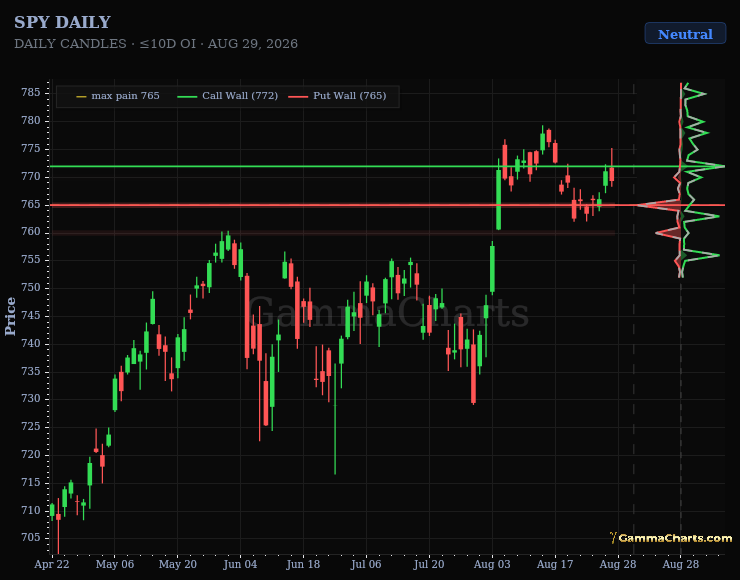
SPY intraday chart
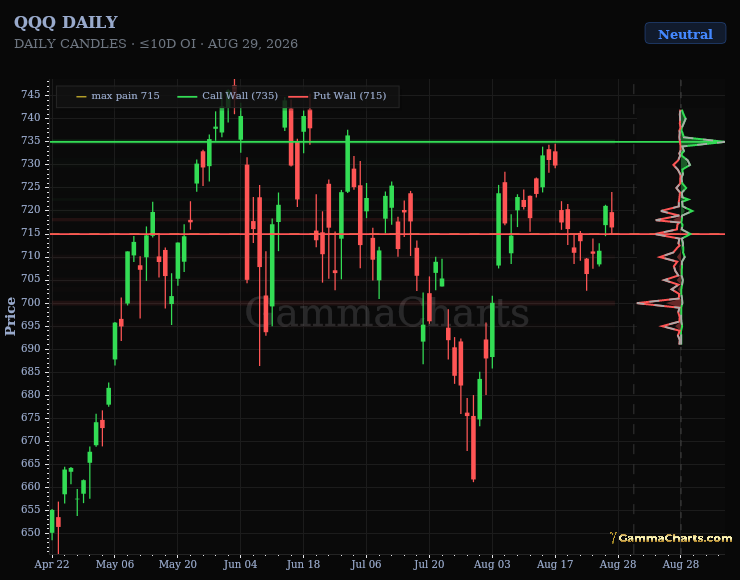
QQQ intraday chart
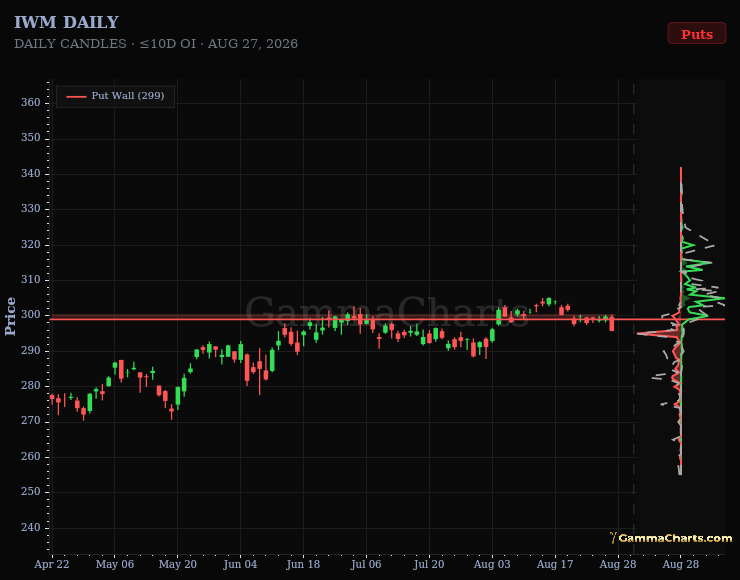
IWM intraday chart

Sigma Bands

Session price boundaries are scaled from VIX using the Rule of 52. As elapsed RTH time grows, the ±1σ envelope fans out from each session open. Bands tighten or widen when implied vol moves.

Price inside the band is a routine session move. Price pressing the outer band late in the day often marks continuation. Early-session breaks that fail to hold outside the band tend to mean-revert.

Greek Exposure profile

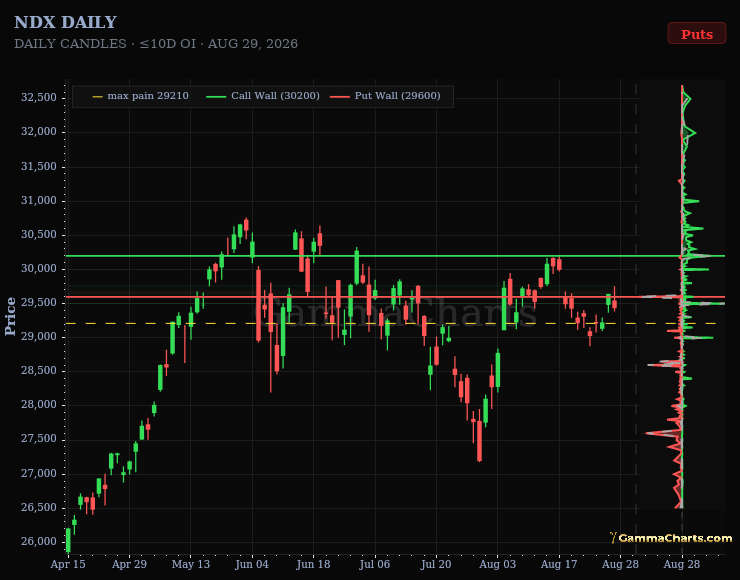
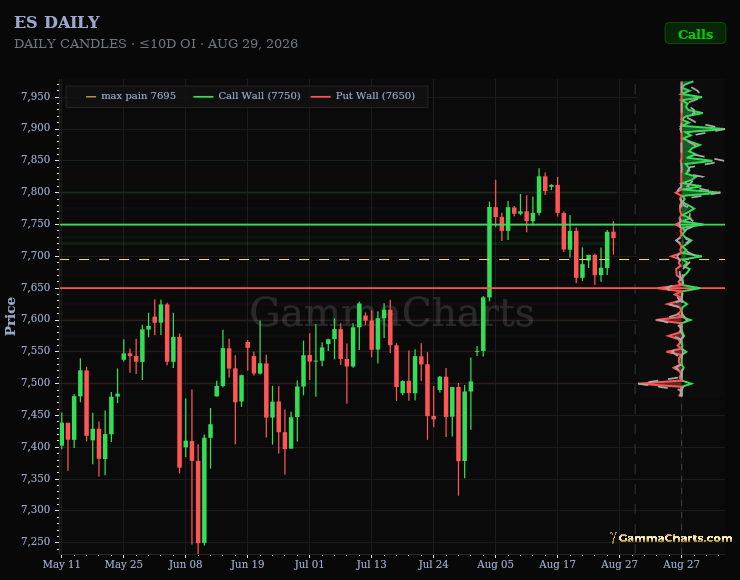
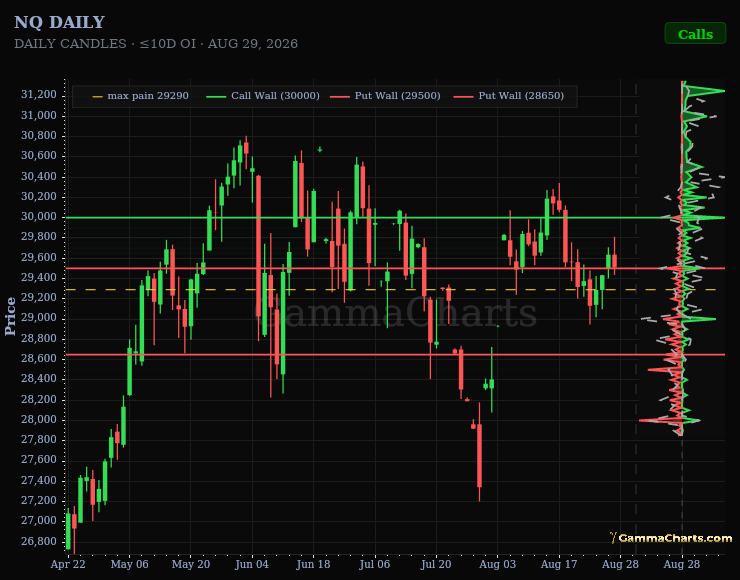
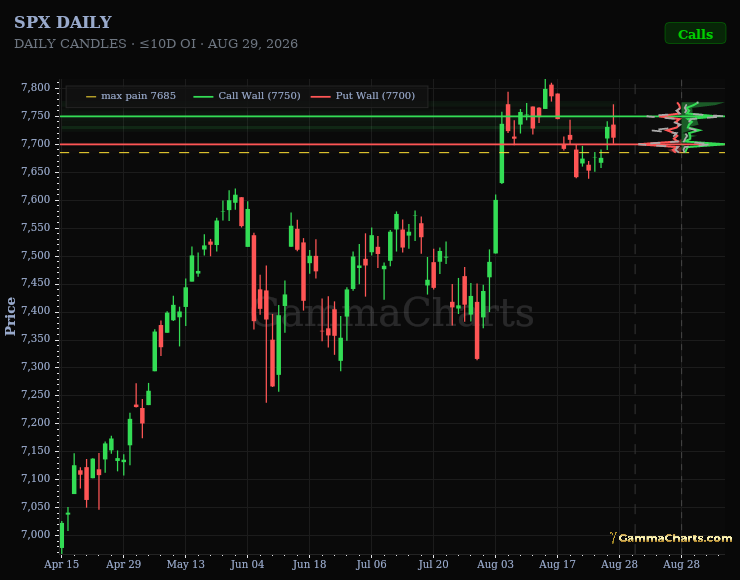
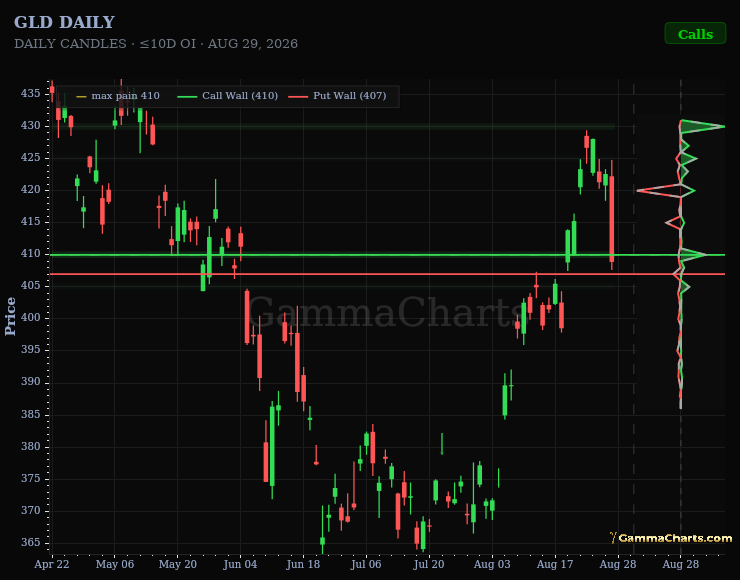
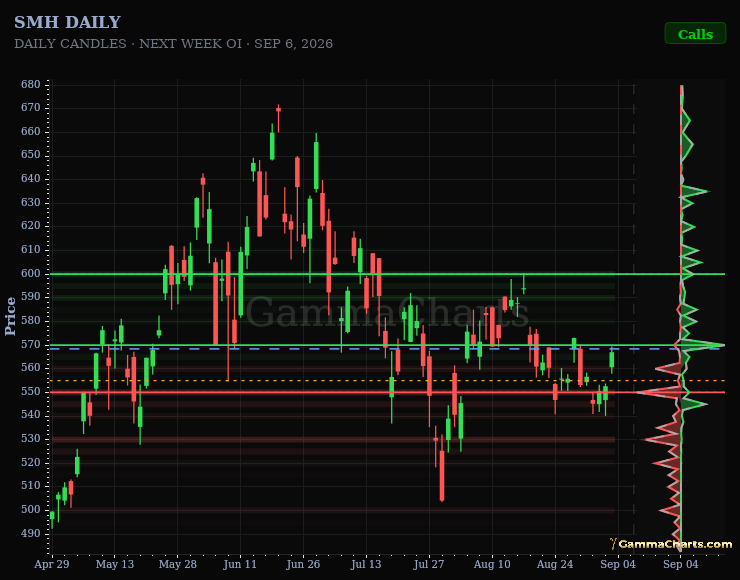
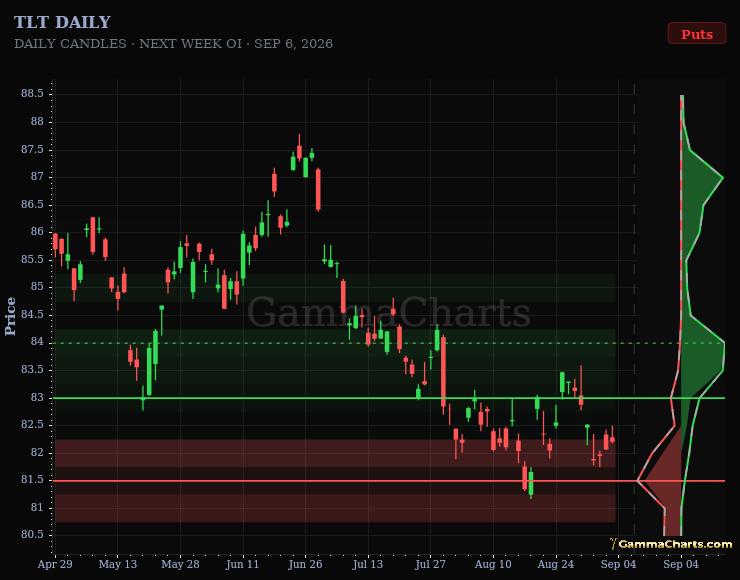
The right-hand panel compresses the same dealer-gamma (Γ) strike view as Greek Exposure on the Gamma page. Strikes run vertically; exposure runs horizontally. Contracts blend 0DTE and the next Friday weekly expiry.

A dashed vertical line at the center of the panel is zero net gamma. Read left and right from that line for signed net exposure only. The separate call and put curves do not use left/right for sign.

How to read the profile

The panel stacks three independent layers. At each strike, check all three before inferring dealer positioning.

  • Call Γ (green curve) — call-side gamma magnitude at that strike. Bulges left from center. Scaled to the largest call node on the chart.
  • Put Γ (red curve) — put-side gamma magnitude at that strike. Also bulges left from center. Scaled to the largest put node on the chart.
  • Net gamma fill — signed dealer gamma: call Γ minus put Γ at that strike. Green fill extends right of center when net is positive (call dominates). Red fill extends left when net is negative (put dominates). No fill when net is near zero. Width is scaled to the single largest |net| strike on the chart.

A tall red put curve does not by itself mean net short gamma. OTM strikes often show large put-side size while call gamma at the same strike offsets most of it. Trust the fill direction and width, not the curve bump alone.

  • ex nearest — dashed gray curve: next-Friday expiry only (what-if with 0DTE stripped). Positive net fills right, negative left, same sign rule as the main fill.
  • Header badge — net gamma at spot in $B (same sign convention as Greek Exposure).

Gamma levels on price

Horizontal levels on the candle panel use the same wall and flip logic as Greek Exposure.

  • Call / put wall — solid green and red lines; largest call-GEX strike above spot and largest put-GEX strike below spot (0DTE chain).
  • GEX ceiling / floor — dotted green and red; outer strikes on the net-gamma curve.
  • Gamma flip — dashed line where net dealer gamma changes sign.
  • Call / put wall* — dashed walls from the next-Friday ghost profile only.
  • Background bands — faint horizontal strips behind price. Same net gamma rule as the profile fill: green when net is strongly positive, red when net is strongly negative, nothing when net is neutral. Each strike gets one color or none. Bands use the same global |net| scale as the profile fill, so the dominant wall (often the call wall) sets the brightness of every other strike. A large put curve with weak net may show no band.

Open the full Greek Exposure chart on Gamma for vanna, charm, vomma, and per-expiry S-curves.

Net Drift

@gammacharts
ES net drift chart
NQ net drift chart

Net Drift

Cumulative call and put premium paid on near-dated ES and NQ options during NYSE regular hours. Green is net call premium drift; red is put premium drift. The blue line is the underlying future. Volume strip below shows cumulative contracts traded.

Rising put drift with falling price often marks bearish hedging flow. A late-session put spike near the close can show last-minute protection buys. Data refreshes every 30 minutes during RTH from GLBX trades (DTE ≤ 7).

Score Card

@gammacharts

Score Card

Cross-market regime badges updated from the latest macro, credit, equity, and volatility data. Each tile links to the full chart on Macro, Economy, or Volatility.

Macro ratios (IWM/SPY, GLD/SPY, RSP/SPY) use the same 20-day momentum badges as the Macro summary chart. Hover a tile for level, 20d Δ, and 1yr percentile.

Volatility tiles (VIX, skew, dispersion, VRP) use the same full-history z-score badges as Volatility Summary. Hover for raw level and z. Term structure, DIX, and GEX use their dedicated chart classifiers.

Green on vol tiles means normal vs history; green on macro ratio tiles means bullish momentum for that pair.