Macro summary

@gammacharts
Macro summary � cross-asset ratio composite

Macro ratio summary

Six cross-asset ratios in a 2×3 grid. Together they form a quick-read dashboard on macro risk appetite — breadth, size, credit, defensives, gold, and growth vs defensive rotation.

Read each panel independently; badges reflect a 20-day move vs a 1% of current ratio threshold.

Sub-charts

  • RSP / SPY — Equal-weight vs cap-weight S&P. Measures concentration into a few names vs broad participation. Rising = breadth expanding; falling = narrow mega-cap leadership.
  • IWM / SPY — Russell 2000 vs S&P 500. Small-cap vs large-cap risk appetite. Rising = small caps leading; falling = large-cap dominance / fragile rally.
  • XLU / SPY — Utilities vs the broad market. A pure defensive-rotation gauge. Rising = defensives leading (risk-off); falling = cyclicals and beta in favor.
  • GLD / SPY — Gold vs equities. Safe-haven demand vs risk assets. Rising = gold bid / equity skepticism; falling = equities holding preference over bullion.
  • HYG / TLT — High yield vs Treasuries. Tracks credit risk appetite relative to safe duration. Rising = credit risk-on; falling = spread stress / flight to quality.
  • XLK / XLU — Tech vs utilities. Growth/cyclical leadership vs defensive staples. Rising = growth leading; falling = late-cycle defensive rotation.

Badge states

  • Each sub-chart shows a pair-specific badge (for example NARROW LEADERSHIP, CREDIT STRESS, or GROWTH LEAD) based on recent ratio momentum and whether rising or falling is risk-off for that pair.

Macro Compass

@gammacharts
Quad Map
Month Quad Growth Infl
Jun 26 Quad 2 +0.1% +0.4%
May 26 Quad 2 +0.0% +0.1%
Apr 26 Quad 1 +0.0% -0.1%
Mar 26 Quad 1 +0.0% -0.0%
Feb 26 Quad 3 -0.2% +0.0%
Jan 26 Quad 3 -0.2% +0.1%
Dec 25 Quad 3 -0.1% +0.1%
Nov 25 Quad 2 +0.1% +0.2%
Oct 25 Quad 2 +0.2% +0.1%
Sep 25 Quad 2 +0.0% +0.1%
Aug 25 Quad 4 -0.0% -0.1%
Jul 25 Quad 4 -0.0% -0.2%
Jun 25 Quad 1 +0.1% -0.1%
Quad Map
Month Quad Growth Infl
Jun 26 Quad 3 -0.1% +0.3%
May 26 Quad 3 -0.2% +0.2%
Apr 26 Quad 3 -0.1% +0.2%
Mar 26 Quad 4 -0.0% -0.0%
Feb 26 Quad 2 +0.2% +0.1%
Jan 26 Quad 2 +0.1% +0.0%
Dec 25 Quad 2 +0.0% +0.1%
Nov 25 Quad 4 -0.0% -0.1%
Oct 25 Quad 1 +0.0% -0.3%
Sep 25 Quad 1 +0.1% -0.4%
Aug 25 Quad 1 +0.0% -0.2%
Jul 25 Quad 3 -0.1% +0.1%
Jun 25 Quad 2 +0.2% +0.2%
Quad Map
Month Quad Growth Infl
Jun 26 Quad 1 +1.7% -0.9%
May 26 Quad 1 +0.7% -0.6%
Apr 26 Quad 3 -0.9% +0.4%
Mar 26 Quad 3 -0.8% +1.1%
Feb 26 Quad 2 +0.0% +1.6%
Jan 26 Quad 2 +0.6% +0.2%
Dec 25 Quad 2 +0.1% +0.5%
Nov 25 Quad 1 +0.2% -0.1%
Oct 25 Quad 4 -0.4% -0.2%
Sep 25 Quad 1 +0.2% -0.6%
Aug 25 Quad 1 +0.4% -0.9%
Jul 25 Quad 1 +1.0% -0.2%
Jun 25 Quad 2 +0.3% +0.4%
Quad Map
Month Quad Growth Infl
Jun 26 Quad 2 +0.5% +0.1%
May 26 Quad 2 +0.1% +0.1%
Apr 26 Quad 3 -0.2% +0.1%
Mar 26 Quad 3 -0.2% +0.2%
Feb 26 Quad 2 +0.0% +0.4%
Jan 26 Quad 2 +0.1% +0.1%
Dec 25 Quad 3 -0.0% +0.2%
Nov 25 Quad 2 +0.0% +0.0%
Oct 25 Quad 4 -0.1% -0.1%
Sep 25 Quad 1 +0.1% -0.1%
Aug 25 Quad 1 +0.1% -0.3%
Jul 25 Quad 1 +0.2% -0.1%
Jun 25 Quad 1 +0.1% -0.0%

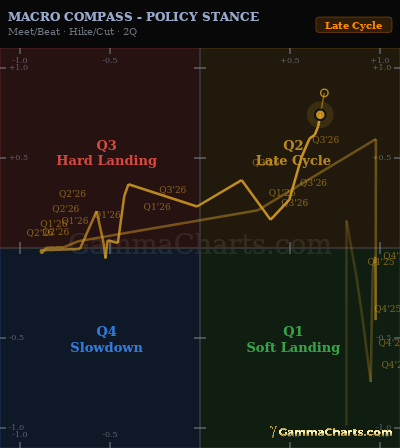
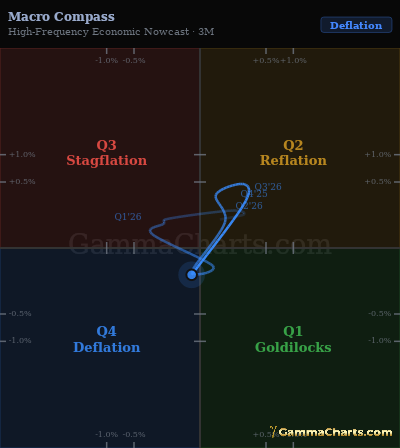
Macro compass

The Macro Compass places the economy in one of four regimes based on whether growth and inflation are currently accelerating or decelerating. These four quadrants define distinct environments with very different implications for which assets perform and which struggle.

The chart is built from multiple methodologies — high-frequency nowcasts, yield curve signals, equity rotation, and soft economic data — with an All tab that blends active legs. Use the regime to calibrate your sector and asset class positioning, not as a trade signal, but as the lens through which to interpret everything else.

Badge states (quadrants)

QUAD 1 — Goldilocks
Growth is accelerating while inflation is decelerating. The ideal environment for risk assets. Equities and credit tend to outperform. The Fed is broadly neutral or easing.
QUAD 2 — Reflation
Both growth and inflation are accelerating. Commodities and cyclicals outperform. Nominal assets compress in real terms. The Fed faces pressure to tighten.
QUAD 3 — Stagflation
Growth is decelerating while inflation remains elevated. The worst environment for equities and credit. Real assets and short-duration instruments tend to hold value best.
QUAD 4 — Deflation
Both growth and inflation are decelerating. Long-duration bonds tend to outperform. Equities face earnings risk. The Fed typically has room and motivation to ease.

Sector Rotation

@gammacharts
Benchmark Indexes
11 S&P Sectors
S&P Themes
Maga Cap

Sector rotation

The Relative Rotation Graph maps where each name sits in its performance cycle relative to the benchmark. The X-axis is relative strength (outperforming vs underperforming); the Y-axis is relative momentum (improving vs fading). The trail shows recent rotation path.

Names tend to move clockwise: Improving → Leading → Weakening → Lagging → back to Improving. Use it to spot early leadership (Improving) vs late-cycle peaks (Weakening).

Tabs

  • Benchmark Indexes — SPY, QQQ, IWM, DIA, TLT, GLD. Cross-asset leadership: large-cap vs growth vs small-cap vs Dow, plus duration and gold as risk-off anchors. Use this tab for macro regime — which beta sleeve is winning.
  • 11 S&P Sectors — GICS sector ETFs (XLK, XLF, XLV, XLE, etc.). Classic sector rotation wheel. Use this tab for cyclical vs defensive positioning and where institutional flow is rotating within the index.
  • S&P Themes — Thematic sleeves: semis (SMH), credit (HYG), EM (EEM), biotech (XBI), regional banks (KRE), homebuilders (XHB), metals (XME), bitcoin (IBIT), China internet (KWEB), and DRAM. Use this tab for risk-on / risk-off themes beyond plain sector labels.
  • Maga Cap — Mega-cap single names (META, MSFT, GOOGL, TSLA, AMZN, NVDA, AAPL, TSM, AVGO). Tracks whether index leadership is narrowing into a handful of names or broadening out. Pair with RSP/SPY on Macro for participation context.

Quadrants

LEADING
Outperforming the index and momentum is positive. Established relative strength.
WEAKENING
Still outperforming, but momentum is fading. Often late in the relative cycle.
LAGGING
Underperforming with negative momentum. Weakest relative phase; watch for bottoming into Improving.
IMPROVING
Underperforming but momentum turning up. Often the earliest rotation entry.

Sector Heatmap

@gammacharts
Benchmark Indexes
11 S&P Sectors
S&P Themes
Maga Cap

Sector Heatmap

"Price is advertising, volume is signal"

The Sector Heatmap ranks rolling relative performance. This approach strips away the noise of the broader market and reveals the true winners and losers in any given timeframe.

Reading the chart

  • Rank cards — today's relative performance rank per asset.
  • Curved trails — how rank changed across prior periods (rotation path).
  • Switch preset tabs (sectors, themes, Mag 7) to match the universe you track.

How to use it

  • Names climbing toward rank 1 while the benchmark lags — early leadership.
  • Defensive sectors rising in rank while growth slips — late-cycle rotation signal.
  • Confirm with the RRG on Macro/Breadth for momentum vs strength quadrants.

Weighted S&P Advance/Decline

@gammacharts
Weighted S&P Advance/Decline

Weighted S&P advance / decline

Standard breadth indicators treat every stock equally — Apple and a micro-cap count the same. This chart weights each stock's advance or decline by market capitalization, so the signal reflects where actual money is flowing, not just headcount.

When cap-weighted breadth diverges from equal-weighted breadth, it reveals whether large-cap mega-tech is masking weakness beneath the surface, or whether small and mid-cap stocks are leading a rotation the index hasn't captured yet. A healthy bull market sees breadth expansion across all size segments.

Badge states

  • Hold long — Both readings positive; cap-weight leading. Do not fade.
  • Hold short — Both readings negative; cap-weight leading down. Do not fade.
  • Regime flip — Both crossed above zero; early bull trigger.
  • Regime flip — Both crossed below zero; early bear trigger.
  • Lagging — Histogram diverging from the equal-weight line; weak follow-through.
  • Mixed — Signs diverging; cut size.
  • Neutral / Compression — Flat or near zero; chop risk.

Rethinking Rotation and Dispersion

@gammacharts

Traditional portfolios, like a 60/40 mix, rely on a simple rule: own different assets and rebalance them regularly. When stocks rise and bonds drop, you automatically sell high and buy low. This regular rebalancing boosts returns without needing to predict the market.

Sector rotation uses a similar discipline but shifts money toward sectors showing strength, rather than just buying what fell. This works well in a normal economic cycle. However, long-term inflation can disrupt traditional asset relationships. In those environments, it is better to invest in emerging leaders and follow the trend. Use the data on this page to see if the whole market is moving together or if individual stock-picking matters more.